
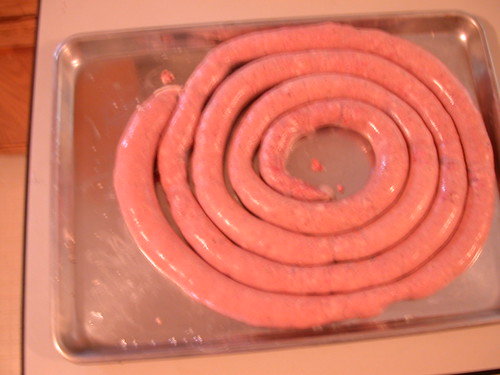
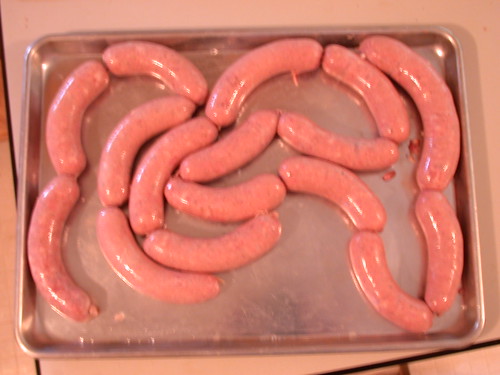
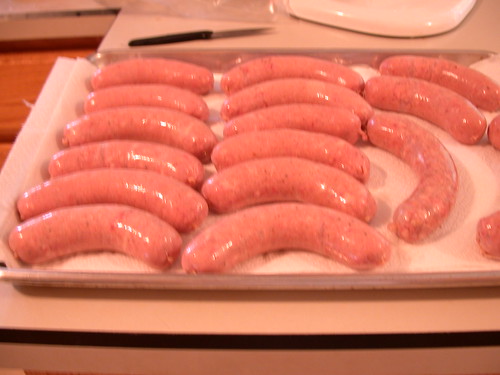
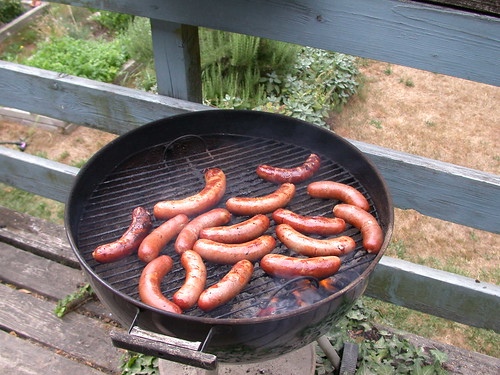
Making sausage at home isn’t hard. The basic thing to remember is that sausage is essentially just ground meat mixed with salt and seasonings of some kind. It doesn’t have to be stuffed into casing and it doesn’t even have to be formed into patties. The basic idea is to take tough cuts of meat and grind them in order to make them easier to cook and eat. You can make perfectly serviceable sausage by buying ground pork, beef, lamb or poultry and then spicing it yourself.
But of course, the more of the process you get involved in, the better the end result and the more control you’ll have over the whole process. You don’t need a huge amount of equipment but a meat grinder is helpful as is some kind of stuffing attachment if you want to make links. I have a Kitchen Aid mixer and use their grinder and sausage stuffing attachment which is fine. The grinder isn’t ideal in that the knife blades are difficult to sharpen and sometimes the results seem less like ground than slightly torn or pulverized, but it’s OK for most applications. If you really get serious, get a good grinder and take good care of the grinding knife.
If there is one primary rule in making sausages, it’s to keep everything very cold (bordering on or slightly freezing). This includes the grinder and stuffer, as well as the meat. In fact, the meat should be slightly frozen to cut a good grind and to keep from getting “smear.” Smear is the sausage maker’s nightmare and it’s to be avoided at all costs. Most sausage is about 25-30% fat. Smear occurs when the fat gets broken down and is smeared into the meat. The fat separates and when the sausage cooks, the fat and meat separate resulting in stringy, pasty meat and pools of fat (plus they make the sausage shrink and you can see big pools of fat in the casings, yuck). If you keep everything during grinding, mixing and stuffing you’ll be fine, but that’s why sausage making is best done in a few steps: grind the meat and then re-chill it in the freezer; mix the meat and the spices and then re-chill it; and then stuff them.
Most home grinders come with two different size plates: 3/8 and 1/4 inch. 3/8 is the better grind for coarser styles like Italian sausage, chorizo, etc, but I generally prefer the 1/4 plate for brats. If you can only choose one size, though, go with the 3/8 grind which is like a chili grind from the supermarket. If you want really coarse, rustic sausages, hand cut a portion of the meat into tiny cubes. I normally will hand cut about 1/3 of the meat for a coarser more rustic look.
Salt is essential for any sausage and quantities vary but a good rule of thumb is one teaspoon of salt per pound of meat, but some varieties will be considerably higher. There’s a big debate about “pink salt” because it contains nitrites. If you’re going to cold smoke your sausages for any length of time, use nitrates, because botulism is a real threat and scary reality. Cold smoking normally means smoking food between 80and 100 degrees. Botulism requires moisture and an absence of oxygen to grow, and a cold smoker is a perfect environment for it. If you wouldn’t leave thawed meat out on the kitchen counter on a hot summer day for 8-12 hours, then you probably should add pink salt to your sausage. Pink salt is premeasured and generally contains 94% salt and 6% nitrite. One level teaspoon per five pounds of meat is plenty to keep botulism and other nasties at bay. If you’re going to make sausage that’s going right onto the grill or that will be hot smoked at higher temperatures don’t bother.
When you get started it pays to use some recipes at first until you’ve done a few batches, at which point I would encourage you to go hog wild and add whatever sounds good. There are several great resources to check out. For supplies, The Sausage Maker and Butcher and Packer are both reputable and reliable sources. For books, check out Michael Ruhlman and Brian Polcyn’s Charcuterie which is a masterpiece for both beginners and advanced sausage makers. A great book for beginners is Bruce Aidell’s Complete Sausage Book, which will teach you to make sausages and will also give you recipes to use them in. The old school bible for sausage makers (which is geared more to professionals, but is well worth tracking down) is Rytek Kutas’s Great Sausage Recipes and Meat Curing. The recipes are generally for 10, 25 and 100 pound batches, but they scale down nicely. There’s a great web site by a gentleman named Len Poli which is a terrific resource as well.
A few more tips if you haven’t tried this yet. Start with a basic fresh sausage, whether it’s a breakfast variety, sweet Italians, Brats, etc. Dried cured sausages like salami are very difficult and require temperature and humidity control and can require bacterial cultures as well. Emulsified sausages like weisswurst and frankfurters are do-able but have their own special challenges and aren’t the best type to try for your first batch. I normally make pork sausage, and I generally some cut from the shoulder (shoulder roasts or Boston butts are great). If you want beef, go with chuck. These cuts will give you enough fat without having to find fat back, which is a special order unless you have a really good butcher. If you use chicken, use thighs and tried to use some skin as well or they may be a bit dry.
So give it a try and you’ll likely be well rewarded by your efforts.
Wednesday, August 29, 2007
A Sausage Making Primer


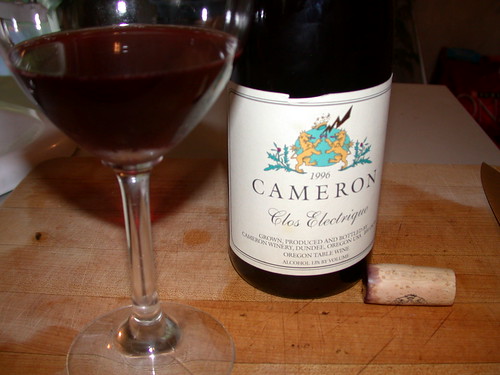
Cameron Clos Electrique With Pork Loin Chops and Potato Corn Cakes
We’re in full tomato season, which means that if even a day goes by when we don’t eat tomatoes, we risk being overrun by them. In some ways, this makes planning meals easy, because when you think what vegetables you want to use, you automatically know that tomatoes will be one of them, but it also means that you need to think of new things to do with tomatoes, or face culinary boredom. Even though we planted zucchini as well, we’re not as overwhelmed with those, but we do have a few.
We’ve been getting remarkable poblano peppers and sweet corn of late, and I had been thinking about making some kind of corn, potato, and poblano pancakes and wanted to use them as a base for some kind of grilled meat. I needed to work the tomatoes in, so I opted to make a cherry tomato, Walla Walla sweet onion, and zucchini compote to go around the whole dish.
I still had some pork loin chops from a whole loin that I had bought so I decided to brine a few of those and grill them over charcoal and hickory. There would be enough flavors going on in the compote and corn and potato cakes and I didn’t want to add anything else to the pork because I was afraid everything would be too busy. Besides, a grilled, brined loin chop should have plenty of flavor on it’s own. I felt like drinking wine instead of beer, even though I was cooking with some chilies. Because all the ingredients were all local, I decide to keep to an Oregon wine. I love Oregon Pinot Noir, but don’t drink as much of it as I used to. This is partly because of price, and partly because my tastes have really been geared towards Southern French and Spanish wines of late. But good pinot is a remarkably food friendly wine.
I pulled my last bottle of 1996 Cameron Clos Electrique. Clos Electrique is Cameron’s top bottling of Pinot Noir. A “clos” is a walled vineyard and in this case, the wall is an electric fence, hence the name Clos Electrique. The 1996 is still drinking beautifully. It’s a deep garnet red with just the slightest hint of brick at the edge. The nose is a big, intense blend of red berry and bing cherry, smoke and vanilla. There’s an almost “chocolate covered cherry” note to it. On the palate, the wine is rich with deep layers of fruit, good acidity, and a long finish that mixes the fruit and smoke. It’s aged beautifully. Considering how approachable it was in its youth, it’s remarkable how intense and lively it is at 11 years old. It was one of the best Oregon pinots I had drunk in quite some time and made me realize why I love these wines so much.
The meal was very good, but the corn and potato cakes need to be reworked a little bit. I started with three russet potatoes and three ears of corn, a poblano chili, an egg, and a little flour to help bind it all. Unfortunately, there should be a little less corn and a little more potato. I didn’t want a batter based corn cake. I wanted the potato starch to hold it all together and figured the egg and flour would help, but I found that I could have used more potato because you need to completely get the corn kernels enmeshed in the cake or they end up in the bottom of the pan. The mix I had worked, but they were difficult to flip and to plate. Once they were on the plate, I didn’t really care, but it did require two spatulas and a quick transfer.
The Walla Walla onions in the compote had been caramelized to a sweet, rich mass and I added the quickly sautéed zucchini and briefly cooked tomatoes to it. It had a rich sweet note that worked well with the corn and the natural sweetness of the pork. The chili heat was balanced by the sweetness of the compote as well. The Clos Electrique had beautiful sweet fruit flavors but also had a fair amount of acidity which helped to cut through all of the rich flavors. If the pork had been sautéed, I likely would have added a tiny amount of sherry vinegar when I deglazed the pan and the spooned that over the pork, because another touch of acidity like that would have been nice, but it was still a great meal.

Saturday, August 18, 2007
A trip to Belmont Station
We met some friends over at Belmont Station last night. None of us had been there since they moved from their location next door to the Horse Brass Pub, which is a Portland beer landmark and one of the best beer bars in the country. Belmont Station used to be a bottle shop that only did beer-to-go. At their new location, they have a café one on side and the bottle shop on the other. You can freely wonder between the sides, and any of the beers available on the bottle shop side can be brought over to the café side and drunk there (for a very slight surcharge), which is a very nice feature.
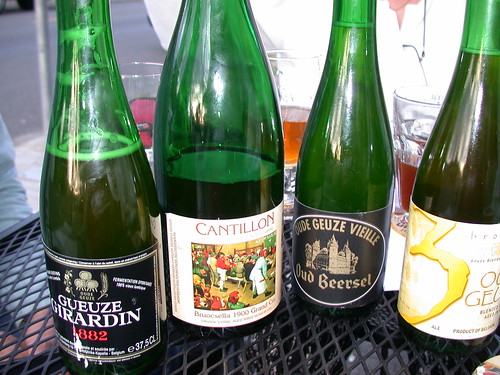
Our friends had recently returned from a trip to Belgium and had been on a Lambic kick since then. Being a big Lambic fan myself, we were able to sit and taste several beers side by side. We chose Cantillon Grand Cru, Girardin 1882 Gueuze, Drie Fonteinen Gueuze, and Oud Beersel Gueuze. The Cantillon was in a 750ml, but the rest were in 375ml bottles. We opened all of them at once so we could compare and contrast them.
The Cantillon was freshly bottled in January 2007 and hadn’t built up much carbonation because it was a relative youngster in the bottle. It still had the distinctive house style and tartness, but wasn’t as tart as older more mature bottles of it I’ve had. The Girardin is a perennial favorite and didn’t disappoint. It was nicely carbonated and poured with a thick billowy head. It had more barnyard than Cantillon and a slight amount of smokiness as well and was my second favorite (after the Cantillon of course).
The Drie Fonteinen was a close third (I really could have gone either way on this one and the Girardin). It was a little funkier and even barnyardier and lacked a little bit of the elegance of the Girardin. The Oud Beersel finished last, but was still a nice beer. It was distinctly sweeter than the others but did have a nice honeyed note to the nose. I would still be happy to drink it, but it was a little outshone by the other three.
After the Lambics, we opted to go with a non-sour beer. They had several French Biere de Gardes but only one, La Bavaisienne, which was an amber. Biere de Garde is a traditional farmhouse style from France and the really traditional style of it is an amber beer. But it’s now available in blonde, amber, and darker varieties. To me the ambers are still the only true Bier de Gardes.
Biere de Garde is a fairly controversial style of beer probably because it’s hard to come up with a consensus of what it really is. Essentially it is a very malt forward style of beer. The aroma should have an intense maltiness, similar to a Scottish ale, but with more earthiness and often some herbalness as well. The hops are essentially there to balance the malt. Some people look for a damp basement or cellar odor (like the BJCP guidelines) which is actually a sign of a bad cork. This is likely because of the poor condition of the beer by the time it was tasted in the US. It’s unfortunate that a beer judging organization, like the BJCP, would help to push this notion.
Despite the heavy malt aroma and malt flavors of the beer, it actually finished quite dry and is an excellent choice with food. Garret Oliver, the talented brewer and beer critic, loves Biere de Garde with Thanksgiving and it is a great choice.
The La Bavaisienne was a delightful beer and a nice change from the intensity of the Lambics. It was in good condition and actually tasted fairly fresh. The aroma was a mix of malt with a slight herbal note. The taste was very full but finished dry with a lingering malt flavor.
At this point we were winding up, but opted to get one more bottle and opted for something bigger and sweeter. I’m a big fan of Green Flash’s IPA’s but had never tried their Barleywine, so we opted for a bottle of that. It had a rich hop aroma. In fact it was a bigger hop nose than most, but not as hoppy as Sierra Nevada’s Bigfoot. The palate was full and rich with a slight brandy-type of flavor underlying the malt. It was a little drier than I expected, but still a very nice beer and a good way to end an evening.
Thursday, August 16, 2007
Sausages, Elysian Avatar IPA and Full Sail Amber
I got stuck working late and had already gotten a call from my wife saying that she was going to go out and meet some friends and wouldn’t be home when I got home for dinner. There are a lot of things my wife won’t eat, like lamb, which I love so I don’t get a chance to eat them that often. This seemed like a great opportunity for that, but I got stuck working until a little after 8:00pm and didn’t feel like getting too involved in a cooking project. Sausages had snuck into my brain and I was hoping to find some lamb sausage that would hit a bunch of my cravings. I hit the local New Seasons market n the way home, because they have a great butcher department and generally very good sausage.
I was looking for lamb sausage and found some lamb, spinach and feta sausage, but also noticed that the pork, Marsala, and fig sausages were on sale, so I got one of those as well. Both sausages had the advantage of containing fruits or vegetables so I was able to convince myself that it would be a balanced meal. I did a quick cruise through the beer aisle and was thinking about trying to score one of those beers that I almost always overlook. Of course I instead got caught up in new things and things I hadn’t tried in quite some time and opted for a bottle of Elysian’s Avatar IPA, which is an IPA brewed with dried jasmine flowers. I had tried it once, years before at an Oregon Brewer’s Fest and decided to try the bottled version.
I got home, threw the sausages in the cast iron skillet and cracked the Elysian. I like Elysian a lot. They’ve won Large Brewpub of the Year award at the Great American Beer Fest, and the honor is well deserved. Their beers are generally very good across the board. I also have a weak spot for them because the head brewer was very fond of my Collaborator Saison which was served at OBF a few years ago and told me it was his favorite beer at the festival.
The Avatar IPA pours with a slightly hazy light copper/orange color with an off-white head. There’s a good floral hop aroma, with a hint of jasmine flower sweetness. There’s an underlying sweet malt and honey aroma and a slight candy note. On the palate the beer is round and medium bodied. There’s a sweet floral taste and a good malt backbone. The hops frame the malt sweetness very well but don’t come on too strong, but there’s a lingering hop bitterness in the finish. Overall, it’s an exceptional beer. The jasmine gives it a floral sweetness that fits very well, but doesn’t overwhelm the beer. It’s a dynamic and interesting beer, but not so much so that it overpowers food. It was good with both of the sausages.
As part of my attempt to retry a lot of beers that I normally overlook (because of the abundance of great beer available everywhere in Portland), I also opened a bottle of Full Sail Amber. Full Sail Amber is one of the old school Oregon craft beers. It was one of the first beers I had when I moved here in 1993. I had always regarded it as a reliable standby that could be found even in places that had a limited supply of craft beer. But like many of the old school beers, it’s widely dismissed or overlooked by my fellow beer snobs, which is a shame. It’s not a flashy beer, but it’s well made and very flavorful. It has a beautiful deep copper color, an appealing nose of caramel malt, toffee, and a piney American hop aroma. It’s medium bodied with a good malt and hop balance and it finishes crisp and dry. It’s an understated, somewhat unassuming beer (at least by modern craft beer standards where brewers seem to push the envelope constantly) which in many ways makes it ideal with food. This is a beer that works with food because it doesn’t demand top billing. It’s full of flavor but has a subtlety that many beers lack. In matching beer and food (or wine and food for that matter), subtlety and restraint often makes for a better match than flamboyance.
Of the sausages, my vote was for the pork, Marsala and fig. I love lamb and would have expected a lamb, spinach and feta sausage to be a little highly seasoned (because feta is so salty), but strangely it seemed a little bland. Perhaps they cut back a little too much on the salt to compensate for the feta. I admit that I use a fair amount of salt in cooking and sausage making and perhaps this sausage was geared towards “modern, healthy palates” that use less salt. It was very good, but I would have preferred a little more pizzazz. The pork, fig and Marsala was quite good. The sweetness of the figs and marsala married well with the inherent sweetness of the pork. It’s a recipe I may well adapt (ie, steal) at some point.
Wednesday, August 15, 2007
Scallop Pasta and La Fin du Monde
I had initially planned to cook some kind of pasta with tomatoes, because my tomato plants are finally starting to come on strong (particularly the cherry tomatoes), but I had to stop by the store on the way home and found some attractively priced scallops, so the menu changed. The scallops were frozen, but unless you meet the boat at the dock (and it’s only been out for one day), chances are that most of the seafood you buy has been frozen at some point, so I generally don’t have a problem with frozen seafood. These were large New England scallops at a good price, so I decided I needed to do something with them. I picked up some mushrooms as well, headed home, and tried to figure out exactly what I was going to cook. Scallops and mushrooms are a good combo and don’t really need much else. I was still thinking about using some of the tomatoes, but I was worried it would make for a dish that was too busy. I settled on sautéing the mushrooms in olive oil with garlic, then searing the scallops in a hot pan and serving it all with pasta.
I put the scallops in cold water to thaw, started to prep the mushrooms, and put water on for the pasta. Mushrooms give off a lot of liquid when they cook, and I generally try to cook them in batches to help reduce the amount of liquid in the pan (which can otherwise turn sautéing into stewing). You don’t necessarily need to remove each batch, but if you only throw in a handful at a time and then brown them before throwing in more, it keeps the liquid from building up too much. I cooked the mushrooms until they were firm and browned, then added the garlic. As the pan got dry, I deglazed it all with amontillado. I love sherry and generally keep fino and amontillado on hand. Amontillado is the more full bodied and flavored of the two and is a great match with mushrooms. Fino would do fine in a pinch, but the amontillado is nuttier and works better.
I pulled the mushrooms out of the pan, added a little more olive oil, and put the scallops in to sear (making sure that I patted then dry first). Scallops cook very quickly and get tough if overcooked, so I let them sit for about a minute and a half, and then flipped them. I gave them about another minute on the second side and pulled them out to rest. I added the mushrooms back to the pan, added the drained pasta (which was penne), some parsley and tossed it all together. The mix was a little dry so I added some of the pasta cooking water in order to add some silkiness to the dish. I put the scallops back, turned the heat off and let it sit for about 30 seconds before plating it. In Italy you don’t add cheese to pasta with fish in it, but I was in the US, so I felt no compunction to skip the cheese, although I’m sure there was a loud groan somewhere from the pasta police.
A few days before, I had picked up a Unibroue La Fin de Monde, which is Belgian style Golden Ale, because it was on sale. Unibroue is a Canadian brewery that brews some of the best Belgian-style beers outside of Belgium. I think it’s fair to say that many of their beers are as good as or better than some authentic Belgian beers. According to their website, this is their beast selling beer and it’s no wonder. It clocks in at 9% alcohol, but is wonderfully balanced. The aroma is full of orange, lemon, spice and malt undertones. On the palate it’s full bodied but finishes fairly dry. There’s a wonderful combination of fruit, malt and spice to the flavor. Because it’s so highly carbonated, it’s very lively on the palate which helps to mask its high alcohol content.
Scallops are fairly rich and with the added mushrooms, you need something that has a fair amount of body and flavor to stand up to it. La Fin du Monde was an excellent choice. It was big enough and complex enough to stand up but because of its carbonation and dryness, it also helped to cut through the rich flavors of the dish. The scallops had a buttery quality to them and the citrus notes of the beer contrasted beautifully with that. I have a tendency to overlook a lot of beers at the supermarket because they’re part of the regular inventory and I’m normally looking for something new that I haven’t tried. A lot of these beers are great beers, but being in Portland, I’m spoiled by the selection. So I tend to overlook some classics, like La Fin du Monde, Trois Pistole (which is my favorite of Unibroue’s beers), and the various beers from Chimay, because they’re so readily available and I’m searching for something new and different. Luckily, I was smart enough to give this beer a second look this time and it reminds me of how many “standards” I overlook on a regular basis. Maybe it’s time to go get one of those bottles of Chimay…
Tuesday, August 14, 2007
Garbage Plates (and David Rosengarten)
I did finally get around to making my garbage plates, which is a specialty of Rochester, NY. A friend of mine had brought me a package of Zweigle’s White Hots, which is an emulsified brat-like sausage from Rochester, NY. A garbage plate has two side dishes, a couple of white hots (you can get other things like red hots, or hot dogs instead), white bread and a chili-like sauce. For the sides you can choose two of the following: French fries, home fries, macaroni salad, or baked beans.
I conferred with my friend because I was unclear if everything was kind of piled on together, or if things were separate. He grew up a few blocks from the original Nick Tahou’s, which invented the garbage plate, but warned me that his recollections of them would be filtered by the fact that he rarely ate them when he was stone cold sober. This fact is, to my mind, part of the appeal. A garbage plate is something you eat late at night after you’ve been out drinking with friends. In many respects, this would make it similar to White Castle Hamburgers, which were a favorite of many friends I had growing up in NY after they had been out drinking. In any event, my friend’s advice was sound. The sides are sort of separate, and the white hots and chili sauce go over the top. You can get to the individual sides, but part of them is also covered with the white hots and sauce.
We had made some barbecue over the weekend and had some leftover baked beans, so that was an obvious choice for one side. I opted to do some oven fries as the other. The white hots are traditionally butterflied and grilled. I had been given the popover type of white hots, so I didn’t butterfly them assuming instead that the heat of cooking would pop them open (a bad assumption on my part actually, since they never popped). The chili-like sauces was out of David Rosengarten’s excellent, It’s All American Food, which is one of the best ethnic and regional American cookbooks I’ve seen. I did a variation of the traditional plating. I put the beans and potatoes on the plate, but put some white bread down as well. The white hots went over the bread (primarily, although they did flop onto other things), and then poured the sauce on.
One other difference was that I was eating my garbage plate as dinner, and not at 2am in the morning. Unlike most garbage plate diners, I would have my beer with it and not before. In many ways this is a dish like barbecue, which requires a lighter bodied, versatile beer. I opted to go with my Belgian Summer Ale (which is about 20% wheat and about 5% alcohol), because it’s easy drinking and light and wouldn’t interfere with the delicious, gooey mess that is a garbage plate. Another good choice would have been one of the leftover bottles of Session lager form last weekend’s barbecue. It fits the bill in a similar way.
The meal was delicious and satisfying and made me think and some of the things that David Rosengarten talks about in his book. David Rosengarten is a food critic, TV cook, and cookbook author. He knows high brow food and knows how to cook. He was a high profile critic in NY and reviewed an astounding number of restaurants in the early days of the culinary revolution in the US. What’s refreshing about his book on American food, is that he realizes that great food doesn’t necessarily mean high brow food. For instance, he prefers a hamburger with Heinz ketchup instead of fancy house-made ketchups that a lot of restaurants were doing in the late 1980’s and early 1990’s. He understands the importance of Hellmans (or Best Foods) bottle mayonnaise vs. homemade. Each has their place, and neither is necessarily a replacement for the other. In a word, he knows how to “slum it” in the culinary world and he’s big enough to not care what others think.
He’s not alone in this either. Many well known cooks and critics like some foods that most foodies (including me at one point) would consider “low brow” and beneath them. Julia Child was fond of Goldfish crackers (which are still one of my weaknesses), and James Beard had a penchant for Kentucky Fried Chicken. I have also been told about a local French chef who after a large service at the International Pinot Noir Celebration (and apparently many glasses of wine) was seen a couple of hours later in a tavern scarfing down a plate of chicken wings and drinking a beer. There’s a lot of snobbiness in the food world, and probably more in the wine world (and there are certainly more than a few beer snobs around, including myself). In this upscale world of cuisine, there doesn’t seem to be a place for garbage plates, Goldfish, Buffalo wings, or bottled mayonnaise. But no one can deny how good some of these foods can be. I wouldn’t expect to see a garbage plate at Le Circe, but that doesn’t mean you can deny how good it tastes. Pick up a copy of Rosengarten’s book and he’ll help you rediscover that a lot of those foods you love but don’t like to admit to, are really that good when they’re made right. After all, if they had never been good, they would never have become so popular.
Sunday, August 12, 2007
Skillet roasted chicken on a potato bed
Although I have some of the key ingredients to make a garbage plate, I opted to make something a little lighter after yesterday’s barbecue. I was thinking of a dish a friend of mine had made once which was a simple roasted dish of chicken, potatoes, mushrooms, and fennel. It was simple, but perfectly done. The vegetables had cooked down and created a wonderful sauce. The chicken which sat on top of it, was moist, but had incredibly crunchy skin. It didn’t hurt that my friend is a professional chef and is the executive chef for a large Italian wine importing company on the Chicago area. He also served me some incredible wines (including a Gaja Sori Tilden Barbaresco, a Ch. Leoville Las Cases, and a limited bottling of a Guigal Gigondas), but in many ways, it was the incredibly simple but perfect food that I remember best.
I was also thinking about a widely used technique in Western Mediterranean food that roasts food on top of a bed of potatoes. Generally, it’s fish roasted over potatoes, but meat and poultry work fine as well. It would be a simple one dish meal but would be lighter than the aforementioned garbage plate (which I will eat within a few days). I opted to go the chicken route and decided a cut up chicken was the way to go. I peeled several potatoes and cut them into thin rounds and placed them in layers in the bottom of a well oiled cast iron skillet. I also added a top layer of sliced onions. I added salt, pepper, thyme sprigs, and another splash of olive oil and placed the skillet into a hot oven without the chicken to allow the potatoes and onions a chance to cook a little. About ten minutes later, I pulled it out and added the chicken pieces, which I had brined for about an hour.
Food like this belongs to a category that I always think of as “French Grandmother food.” It’s a particular type of comfort food that’s based upon simple French country and bistro food. I don’t have a French Grandmother, and I’ve never been to France, but it’s a style of food that I crave. I opted to go with wine instead of beer to go with the whole French country food theme. I pulled out a bottle of 1995 Prieure de St. Jean de Bebian (which, granted, most French Grandmothers probably don’t break out with roasted chicken).
Prieure de St. Jean de Bebian is from the Coteaux de Languedoc region of France. Although it’s not in the famous Chateauneuf du Pape region, the grape varieties that are used are the traditional grapes of that region. There are three main varieties, Grenache, Syrah, and Mouvedre, which are blended in slightly different amounts depending upon the vintage. There is also a section of the vineyard which is planted to a mix of the thirteen varieties of Chateauneuf du Pape, and a small amount of this field blend is also used. It’s one of the top wines of the entire Languedoc region.
Even at 12 years old, this wine is still incredibly dark and purple. There’s no sign of browning at the edge yet as you would expect. The nose is big and rich with dark berry aromas, an earthy tarry quality, vanilla, spice and a hint of bacon. With a blend so close to a Chateauneuf du Pape, you wouldn’t expect the wine to be this big. I haven’t had this wine since its release, and was amazed at how youthful it still is. The fruit flavors are very big, and the tannins are still fairly aggressive. The wine has good acidity and seemed a little tart initially, but with time it opened up more and tartness faded. I worried that it may be a little big for chicken, but was hoping for the best. Luckily I had opened it a little early and there was a chance that it would soften as it sat.
Like most great wines and beers, this one revealed a new side with the food. The harsh side of the tannins and the tartness vanished. It wasn’t too rich or too big for the food. The potatoes and onions had melted into an almost gooey layer and had an almost gratin-like quality. The drippings from the chicken had flavored it and thickened into a rich, viscous sauce. This would be an easy dish to gussy up. A few slices of black truffle in with potatoes or an herbed butter stuffing under the chicken skin (or both) could be the basis for creating a fancy, haute cuisine dish, but this dish shined in its simplicity and once again illustrated the point that it’s hard to improve upon simple dishes, and it’s tough to beat a roasted chicken.